We will use a case-led approach: imagine Alex, a U.S.-based retail trader who wants to move from occasional buys to using Kraken Pro for active limit orders, staking a small allocation, and holding a mix of BTC, ETH, and a couple of altcoins. The scenario reveals how verification, interface choice, wallet custody, and recent operational noise interact — and it gives practical heuristics you can reuse.

Verification: how it unlocks functionality — and why the process is a strategic decision
In our case, Alex must complete Kraken’s identity verification to increase deposit and withdrawal limits, enable margin, and access fiat rails. Verification is not paperwork for its own sake: it gates risk-sensitive features. For U.S. residents, regulatory constraints also determine availability — Kraken is based in the U.S. but excludes residents of New York and Washington from account access, and it restricts service in heavily sanctioned countries. That matters if you travel or change address.
Mechanism: verification typically ties a real-world identity to a blockchain-linked asset hub. Once completed, Alex gets higher fiat limits (USD support), the ability to use Kraken Pro, and access to margin up to 5x on eligible pairs. It also permits advanced withdrawal controls like address whitelisting, which reduces the chance of fraudulent transfers. Trade-off: more verification increases operational access but raises privacy costs and creates a larger attack surface if identity data were exposed. In practice, weigh the marginal benefit (higher limits, pro feature access) against your need for privacy.
Authentication and account protections: MFA, hardware keys, and withdrawal whitelists
Kraken’s security architecture gives Alex several effective levers. Multi-Factor Authentication (MFA) via authenticator apps, and the option to use hardware security keys like YubiKey, are standard. The platform also supports withdrawal address whitelisting — only pre-approved external addresses can receive funds. Mechanism-first: MFA defends against credential theft; hardware keys add phishing-resistant cryptographic checks; whitelists stop remote attackers from moving funds to unknown addresses even if they breach the account.
Limitations and boundary conditions: MFA can be bypassed by sophisticated social-engineering or device compromise. Hardware keys are stronger but require careful backup planning — lose the device and account recovery is harder. Whitelists are powerful but inflexible if you frequently move funds among many wallets. For Alex, a practical compromise is using an authenticator plus a YubiKey for high-value accounts and enabling whitelists for large withdrawals while maintaining a small “operational” address for routine transfers.
Kraken trading: Instant Buy vs Kraken Pro and fee-conscious routing
Kraken offers two trading experiences that reflect a common trade-off: simplicity versus cost efficiency. Instant Buy is accessible but carries higher fees (up to ~1.5% on the standard interface). Kraken Pro is the advanced environment with TradingView charts, a live order book, and a maker-taker fee schedule that decreases as 30-day trading volume grows.
For Alex, the choice is strategic. If you place many passive limit orders that add liquidity, you can earn maker fee rebates on Kraken Pro and materially reduce trading costs compared to repeated instant buys. Conversely, if you make one-off purchases infrequently, the instant interface’s convenience may justify the higher fee. Mechanism insight: maker-taker schedules incentivize liquidity provision; frequent traders should tilt toward Kraken Pro and plan orders to be executed as makers when possible. Also, API access and margin features are confined to the Pro or institutional pathways — important if you run automated strategies.
Custody: Kraken’s cold storage, Proof of Reserves, and the wallet choice
Custody is a false dichotomy if treated only as centralization versus self-custody; the real decision is which risks you accept and which controls you retain. Kraken keeps more than 95% of user deposits in offline, air-gapped cold storage — a mechanism that materially reduces hacking risk for bulk assets. It also publishes cryptographically verified Proof of Reserves audits to demonstrate that held assets exceed user liabilities. Those are strong institutional signals to Alex that Kraken manages custodial risk seriously.
But there are trade-offs. Central custody reduces the operational burden for users and enables fiat rails, margin, and staking. It also introduces counterparty risk: Kraken must remain solvent and well-governed. If Alex values absolute control, the exchange’s open-source self-custodial wallet for eight networks offers a non-custodial option, but with the familiar burden of key management.
Practical heuristic: keep trading and margin capital on Kraken (leveraging cold storage protections for most holdings), but move long-term holdings you intend to HODL to a self-custodial wallet where you control private keys. Use small, tested transfers to and from your custody addresses and enable withdrawal whitelists for your exchange account to reduce the chance of unauthorized transfers.
Staking, fees, and the tax/regulatory context for U.S. users
Kraken supports staking for 24+ proof-of-stake assets and charges a 15% management fee on staking rewards. Mechanism: when you stake on a custodial platform, the exchange pools or validates on your behalf and keeps a cut of yield. For Alex, this is a convenience-versus-cost decision. If you want autopilot yields without running a validator, staking on Kraken is efficient; if you are yield-sensitive and technically capable, running your own node or using a specialized service may beat the 15% cut after accounting for operational costs.
Also remember that staking rewards in the U.S. carry taxable implications: rewards are typically treated as ordinary income at receipt and then capital gains apply on disposition. Kraken’s fiat rails and custodial reporting simplify compliance but may reveal data to tax authorities—another privacy trade-off to consider.
Operational reliability: what recent service notes tell traders
Operational events matter because availability and settlement delays change trading risk. Recently Kraken restored DeFi Earn access on mobile after a degraded performance issue and resolved Cardano withdrawal delays. It also reported investigating bank wire deposit delays with a correspondent bank. For Alex, this is a reminder: platform outages and external banking frictions are not theoretical. They can block access to funds, interrupt margin positions, or delay settlement of trades.
Decision-useful takeaway: keep a contingency buffer in fiat and crypto for temporary liquidity needs, test small deposits and withdrawals after major updates, and monitor Kraken’s status updates when moving large sums. Operational incidents are normal; how the platform responds (speed of resolution, transparency) is the practical signal to watch.
Non-obvious misconception corrected: Proof of Reserves does not eliminate counterparty risk
Many traders interpret cryptographic Proof of Reserves (PoR) as a guarantee that their assets are fully safe. That’s an overread. PoR shows that, at a specific snapshot, the exchange’s custodial holdings exceed its liabilities — useful transparency. But it does not certify ongoing operational competence, insurance against exploits, or correct accounting practices outside the snapshot window. It doesn’t prevent governance failures or future liquidity squeezes. Treat PoR as one valuable signal among many: combine it with audits, cold-storage percentages, public incident history, and governance disclosures when assessing counterparty risk.
Practical checklist and heuristics for U.S. traders signing in and trading on Kraken
1) Complete verification up to the level you need but be mindful of privacy trade-offs. 2) Enable MFA and add a hardware security key for accounts holding significant balances. 3) Use withdrawal whitelists for large transfers; keep a small operational address for routine moves. 4) Prefer Kraken Pro if you will place frequent or limit orders — it’s cheaper for volume and gives better execution controls. 5) Split custody according to horizon: short-term trading capital on exchange, long-term holdings in a self-custodial wallet. 6) Monitor operational status and keep a fiat/crypto buffer for settlement delays. These heuristics turn platform features into day-to-day risk management.
If you’re ready to sign in and explore specific functions like verification steps, Kraken Pro, or wallet features, start at the exchange sign-in page to confirm your account’s available options and regional constraints: kraken.
What to watch next (signals, not predictions)
Watch three signals: updates to fee schedules (which change the maker-taker calculus), changes in custody policy (percent cold vs hot), and the cadence and clarity of operational incident reporting. If Kraken expands its self-custodial wallet support or lowers staking fees, that changes the custody-versus-convenience trade-off. Conversely, recurring bank wire delays or frequent app regressions increase the value of keeping liquidity buffers off-platform. These are conditional implications, not forecasts.
FAQ
Do I need full verification to trade on Kraken?
You can open a basic account, but full verification unlocks higher fiat limits, margin, staking, and Kraken Pro features. For active trading or fiat rails in USD, plan to complete the necessary identity checks; if you live in restricted U.S. states (NY or WA), Kraken access is unavailable regardless of verification.
Is Kraken’s Proof of Reserves a complete guarantee my funds are safe?
No. Proof of Reserves is a transparency tool showing holdings exceeded liabilities at a snapshot. It helps reduce information asymmetry but does not eliminate counterparty, operational, or future solvency risk. Combine PoR with user habits: diversify custody and enable platform security features.
Should I use Kraken Pro or Instant Buy?
Use Instant Buy for quick, infrequent purchases when convenience matters more than cost. Use Kraken Pro if you trade frequently, place limit orders, or need margin/API access — the maker-taker fees and better execution tools will typically lower your trading cost if you trade actively.
How should I split assets between Kraken’s custody and a self-custodial wallet?
A common approach: keep short-term trading capital and assets you stake or margin on exchange; move long-term holdings to a self-custodial wallet where you control private keys. Test transfers in small amounts and maintain backup keys and recovery phrases securely.
Okay, so check this out—I’ve been staking, swapping, and bridging across Cosmos zones for a few years now. Initially I thought every wallet was roughly the same, but then I started using a browser-based tool that made IBC simple and actually enjoyable. On one hand I liked experimenting with novel chains; on the other, I worried about key management, browser security, and lost funds because someone rushed a transaction. I’m biased toward tools that make custody clear and predictable. Keplr was the game-changer for me.
Here’s the thing. Keplr’s UX bridges two big needs: secure key control and smooth inter-blockchain communication (IBC). It’s not perfect—no tool ever is—but it’s consistent, developer-friendly, and integrates with staking dApps on Juno in a way that just works. My instinct said “use something browser-based” when I wanted quick IBC transfers from Osmosis into Juno testnets and mainnet contracts. Actually, wait—let me rephrase that: don’t confuse convenience with careless behavior. Browser extension wallets are convenient, yes, but you must pair them with good habits.

Why IBC matters for Juno users
Short version: IBC turns isolated chains into an ecosystem. Long version: IBC lets tokens, data, and messages travel between zones without centralized bridges, which reduces systemic risk and opens composability. Juno benefits big time because it’s a smart-contract hub for CosmWasm, and composability across Cosmos is the secret sauce for richer dApps. On one hand, Juno’s contracts thrive when liquidity and assets from other chains flow in; on the other, security and UX must keep up—otherwise composability becomes brittle.
When I first started sending tokens to Juno for test deployments, I mis-clicked a denom and nearly lost time reconfiguring my channels. That was annoying. But the learning curve taught me to verify port/channel IDs, review recent transactions, and keep an eye on relayer health. IBC isn’t magical; it’s a protocol that requires attention. Hmm… sometimes that detail-oriented work is tedious, but it’s also how you avoid dumb mistakes.
Keplr in practice: staking, IBC, and everyday security
Short assessment: Keplr balances ease with control. It exposes keys to the browser extension, lets you export mnemonics, and supports hardware key signing workflows (with caveats). My first impression was casual: “This is convenient.” Then I dug in. I read the permissions dialogs. I tested with small amounts. I set custom fee settings when moving funds over IBC. On a technical level, Keplr leverages Cosmos SDK signing mechanisms and supports chain-specific derivation paths, which is vital when juggling Juno, Osmosis, and other zones. Something about that low-level clarity reassured me.
I’m not 100% sure on every edge case—there are areas where wallet and dApp devs still need better UX patterns. For example, token metadata can be inconsistent across chains, leading to denom confusion (that part bugs me). But overall: if you want to stake Juno, run contracts on CosmWasm, or hop assets across zones, using a well-established extension simplifies development and personal operations.
Check this out—if you want to try it yourself, there’s a straightforward way to get set up: install the keplr wallet extension, create or import a wallet, and add Juno to your networks list. Yes, it’s that simple to start testing. But don’t rush; start with tiny transfers until you understand channel states and packet lifetimes.
Common pitfalls and how I avoid them
One mistake I see over and over: users forget chain fees when switching networks. You’ll click “send” and wonder why the transaction fails—usually because the gas denom is wrong or you lack the right native token for fees. Another recurring snag: relying on third-party relayer UIs without checking channel readiness. I’ve watched transfers stall because a relayer was paused for maintenance. On the bright side, these issues are fixable with simple checks: confirm the channel is OPEN, review packet sequences, and monitor relayer status on chain explorers.
Also, guard your mnemonic. Sounds obvious, but I’ve met devs who keep phrases in plaintext notes. Please don’t. Use hardware wallets for larger positions. If you’re using an extension for day-to-day activity, keep the bulk of funds offline. My pragmatic split is roughly: small hot wallet for staking rewards and contract interactions; larger cold storage for long-term holdings. This split has saved me from typos, phishing popups, and once — a malicious dApp that requested excessive permissions. Whew.
Developer perspective: integrating Juno dApps with Keplr and IBC
From a dev’s chair, Keplr eases local testing and onboarding. The API surface (window.keplr) provides straightforward ways to request signatures, suggest chains, and manage accounts. The trick is designing UX that explains the chain context: “Which chain are you operating on?” and “This send will travel over IBC” — these cues reduce user error. Initially I thought I could rely on defaults, but actually, explicit user confirmations work better—less ambiguity, fewer support tickets.
On the IBC side, developers need to consider packet timeouts, out-of-order handling, and token escrow patterns. When crafting contract logic that expects cross-chain messages, assume network delays and packet failures; plan retries and idempotency. There’s also an interesting social layer: if your dApp depends on cross-chain liquidity, coordinate with relayer ops or encourage users to use trusted relayers. That’s practical reality, not a theoretical footnote.
FAQ
Is the keplr wallet extension safe for staking on Juno?
Yes, for everyday staking it’s safe provided you follow basic security hygiene: keep firmware updated, use strong OS protections, and avoid exposing your mnemonic. For larger stakes, pair Keplr with a hardware signer. I use Keplr for quick interactions and hardware for big moves. It’s a balance—convenience vs. absolute custody control.
How do I do an IBC transfer to Juno without losing tokens?
Send small test amounts first. Confirm the channel is OPEN and the counterparty is correct. Verify the denom and fee token. Monitor the relayer and, if possible, use a relayer dashboard to see packet status. If a packet times out, you can usually refund or reattempt depending on your escrow state. These are small steps that avoid dumb mistakes.
Can I use Keplr with hardware wallets on Juno?
Yes, Keplr supports certain hardware integrations. The setup requires a bit of patience but it’s worth it for larger holdings. My workflow: keep interactives in Keplr, but require hardware approval for high-value transactions. That practice reduces risk without killing productivity.
All told, there’s a human element here. I feel a kind of cautious optimism about Juno’s future as an application hub. On one level, the tech stack is robust. On another, user experience needs continual polish—especially around cross-chain semantics. I’m excited, though also annoyed by metadata inconsistencies and the occasional relayer hiccup. But those are solvable problems. If you want a practical next step: install the keplr wallet extension, fund a small test account, and try a simple IBC transfer into Juno. You’ll learn faster than reading another long thread—promise.
]]>Short answer: Rabby is not a magic bullet, but it is a deliberate engineering attempt to turn ambiguous, invisible signing decisions into quantifiable, inspectable events. For an American DeFi user regularly interacting with contracts across Ethereum layer-2s, BNB Chain, and other EVM chains, that shift in information can change routine decision thresholds and operational procedures. Below I explain the mechanisms, trade-offs, and practical implications you should weigh before a download and setup.
How Rabby’s transaction simulation and pre-signature scanning actually work
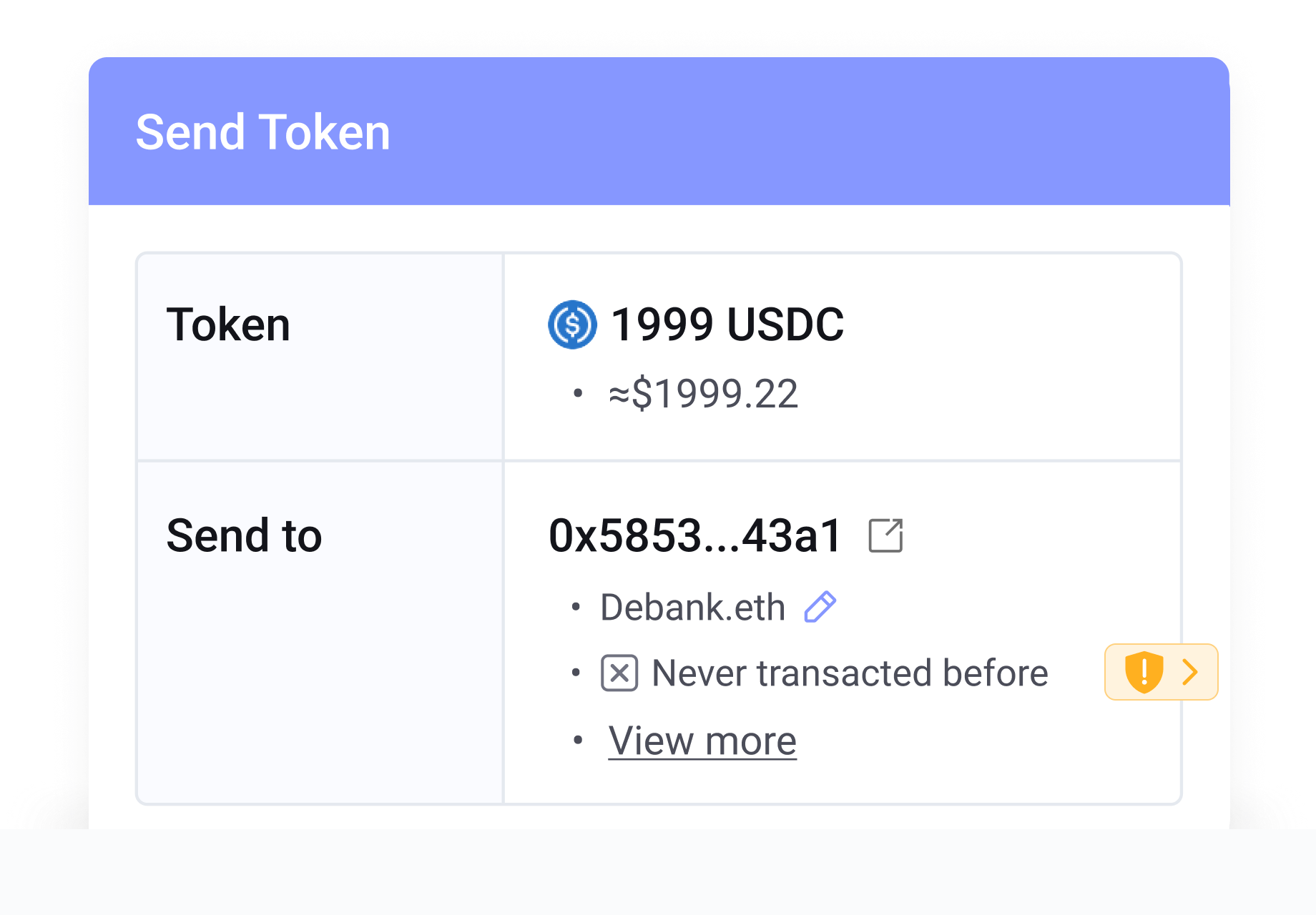
The core mechanism that separates Rabby from many mainstream EVM wallets is deterministic simulation of a proposed transaction prior to signing. In practice that means the wallet takes the raw transaction (destination, calldata, value, gas parameters) and runs it against a node or local VM to estimate the state change that would occur if the chain accepted it. The output is shown as explicit token balance changes, gas cost estimates, and flagged anomalies (for example: approvals to spending contracts, transfers that appear to zero out a balance, or interactions with contracts previously labeled as hacked).
Why this matters: blind signing is a major failure mode in user security. Many phishing and approval-exploit attacks rely on the user not understanding what a signed transaction will actually do. By making the effects visible, Rabby reduces one class of social-engineering and UX-driven errors. The wallet also runs pre-transaction risk scanning — a policy/heuristics layer that highlights suspicious addresses or known-bad contracts — and offers a one-click approval revocation tool to undo dangerous long-lived permissions.
Mechanism limits and boundary conditions: simulation is approximate, not omniscient. Simulations depend on node state, mempool conditions, and accurate ABI decoding. Time-sensitive interactions (front-running, oracle-driven value changes) can render a simulation out-of-date between the moment you review it and when the transaction is mined. Likewise, a simulation cannot predict off-chain actions or the future behavior of a contract that conditionally changes based on external feeds. So treat simulations as a high-quality lens for the immediate call, not as a substitute for defensive operational practices like hardware signing and minimal approvals.
Multi-chain conveniences: automatic network switching, cross-chain gas top-up, and where they help most
Rabby supports over 90 EVM-compatible networks and will automatically switch your active network when you open a dApp tied to a specific chain. For US-based DeFi users who hop between Ethereum L1, Arbitrum, Optimism, Polygon, BNB Chain and Avalanche, that reduces friction and the dangerous habit of trying to transact on the wrong chain. The wallet also provides a cross-chain gas top-up — you can send gas tokens to a chain that otherwise lacks them so a counterparty transaction can complete. These features lower operational errors and save time when running complex cross-chain strategies.
Trade-offs: convenience increases surface area. Automatic network switching is a usability win, but it changes the mental model: you must trust the wallet to pick the right chain and to display accurate simulation outputs for that chain. Multi-chain support also amplifies the importance of keeping hardware wallet integrations current — integrating Ledger or Trezor with Rabby is advisable if you steward significant funds across many networks.
Security posture and historical context: open source, a past exploit, and the realistic implications
Rabby is open-source under an MIT license; that transparency enables independent audits and community review — an important structural safeguard. Openness does not eliminate bugs, however. In 2022, a Rabby Swap smart contract was exploited for roughly $190,000. The team froze the contract, compensated affected users, and increased audit coverage. That incident matters because it illustrates two points: first, even projects that prioritize security can suffer design or implementation flaws; second, a rapid, accountable response (freeze + compensation + audits) is an important signal about developer governance and operational maturity.
How to interpret this as a user in the US: open-source plus reimbursement after an incident leans toward responsible engineering culture, but it is not the same as immunity. Practice defense-in-depth: use hardware wallets with Rabby, keep approvals minimal, and treat on-chain funds as bearer assets that require procedural safeguards (segregate operating funds from long-term cold stores, limit approval magnitudes, etc.).
Where Rabby materially changes your risk calculus — and where it doesn’t
Rabby meaningfully reduces certain classes of user error and attack vectors:
- It reduces blind-signing by showing exact token deltas and gas costs before you sign.
- Its approval revocation tool makes it easier to reduce long-lived allowances that attackers exploit.
- Automatic network switching reduces cross-chain mistakes that can produce failed transactions or accidental exposure.
It does not remove other risks:
- It cannot protect against compromised endpoints (if your browser or OS is infected, signing can be intercepted).
- Simulations can be stale for fast oracle-based interactions or MEV-sensitive flows.
- There is no built-in fiat on-ramp, and the wallet lacks native staking — you will still need exchanges or other services for those functions.
Decision heuristic for power users: treat Rabby as a risk-reduction layer in the signing path rather than a single-point security solution. Combine Rabby’s pre-sign insights with hardware signing, minimal approvals, and a clear separation between high-liquidity trading addresses and long-term cold storage.
Comparing Rabby with common alternatives — not better in all dimensions, but different
MetaMask, Trust Wallet, and Coinbase Wallet are well-known alternatives. Rabby differentiates itself through built-in transaction simulation, automated network switching, and an integrated revocation tool. That makes Rabby particularly relevant for active traders and DeFi power users who need fast, accurate pre-sign information across many chains. However, if you prioritize an integrated fiat on-ramp, or native staking features, other wallets may be more convenient. Institutional users may pair Rabby with multi-sig solutions like Gnosis Safe or custody services (Fireblocks, Amber) to get both the UX and enterprise-grade controls.
In practice many advanced users maintain multiple wallets: a Rabby-enabled browser session for high-frequency DeFi interactions and a second, siloed wallet for larger holdings or long-term positions. That pattern lets you exploit Rabby’s information advantages while keeping exposure laminated.
How to download, set up, and harden Rabby for US-based DeFi workflows
Rabby is available as a Chromium-based browser extension, mobile apps for iOS and Android, and desktop clients for Windows and macOS. A sensible setup sequence for a DeFi power user:
- Download the client from an official source. Verify checksums if you can and prefer vendor pages aggregated by trusted sources (the project provides official links; consult them directly here).
- Create a new seed for an “active” hot wallet and import nothing else into it. Use this wallet for day-to-day DeFi interactions only.
- Connect a hardware device (Ledger, Trezor, Keystone, etc.) and require it for any high-value operations.
- Enable the revision/revocation habit: after any approval, check the approvals dashboard and set a calendar reminder to audit allowances weekly or after large sessions.
- Segment funds: keep minimal gas and trading balances in the hot wallet; store the rest in an offline or multi-sig vault integrated via Rabby for periodic operations.
Limitations to accept up front: Rabby does not directly handle fiat on-ramps or native staking, so those processes will still require external platforms. Also, the wallet’s protection depends on the quality of the node or simulation backend it uses; in adversarial or degraded network conditions, exercise extra caution.
What to watch next — signals that should change your behavior
Monitor audit reports, changelogs, and any incident disclosures from the Rabby team. Useful signals include: updates that expand hardware wallet support, improved simulation fidelity (for example, explicit oracle-state snapshots), and transparent responses to any future security incidents. Conversely, long delays in patching third-party integrations, or opaque handling of incidents, should increase your operational guardrails (pause large approvals, move liquidity to safer custody). The small, steady improvements in toolchains — better ABI parsing, richer simulation outputs, or integration with on-chain threat feeds — are the changes that will incrementally shift how safe “hot” DeFi operations can be.
FAQ
Is Rabby safe enough to replace MetaMask for heavy DeFi use?
Rabby offers stronger protections around signing decisions via pre-transaction simulation and revocation flows, which can reduce user-driven errors. However, “safe enough” depends on your operational practices. For heavy DeFi activity, combine Rabby with hardware signing and multi-sig custody for larger balances; use Rabby for active, time-sensitive trades and approvals where its simulation provides concrete value.
Can Rabby prevent all scams and contract exploits?
No. Rabby reduces certain vectors — blind signing, stale approvals, and accidental network mistakes — but it cannot protect a compromised endpoint, nor predict every oracle-driven exploit. Treat the wallet as a measurable improvement in the signing path, not as a complete substitute for cautious operational practices and layered custody.
How accurate are Rabby’s transaction simulations?
Simulations are generally accurate for stateful contract calls against current chain state; they estimate token deltas and gas. Accuracy degrades for transactions that depend on rapidly changing external values (oracles), mempool ordering (MEV), or external off-chain approvals. Use simulations to reduce ambiguity, but assume short time-sensitivity in fast markets.
Does Rabby integrate with hardware wallets and institutional tools?
Yes. Rabby supports many hardware devices (Ledger, Trezor, Keystone, and others) and integrates with institutional multi-sig and custody solutions like Gnosis Safe, Fireblocks, Amber, and Cobo Wallet. These integrations are important if you plan to use Rabby in an institutional or team setting.
Final takeaway: Rabby changes the information environment of signing. For US DeFi power users, that shift is substantive: it transforms previously opaque approvals into inspectable transactions and makes network mistakes less frequent. But the wallet is an escalation in operational capability, not a substitute for provenance checks, hardware signing, and cautious fund management. If you prioritize pre-sign transparency and work across many EVM chains, Rabby deserves a spot in your toolkit; just add it to an ecosystem of layered defenses rather than relying on it alone.
]]>Here’s the thing. Privacy in crypto often gets treated like an optional extra, like a sticker you slap on a product page. Monero approaches privacy as the whole point, not an afterthought. That shift changes the conversation. Seriously?
Let me be upfront: I’m biased. I care about privacy the way some folks care about good coffee—maybe a little too much. But biases also come from patterns you notice over time. Initially I thought Monero’s opaque ledgers would make it clunky for everyday use. Actually, wait—let me rephrase that: it felt like a tradeoff I wasn’t sure most people wanted. On one hand, convenience; on the other, real anonymity. Though actually, as I used it more, those tradeoffs looked different.
Short story—Monero blends practical design with heavy-duty cryptography so transactions are untraceable by design. That matters. A lot. Especially for users in hostile jurisdictions or anyone who values financial privacy. Something felt off about mainstream claims that “blockchain = transparency,” because transparency is exactly the wrong thing for many cases.

How Monero Makes Transactions Private (Without Turning Your Head Inside-Out)
Okay, here’s a quick walk-through. Monero uses ring signatures, stealth addresses, and confidential transactions. Those are buzzwords, but they do real work: they hide who sent what, who received it, and how much was moved. My first impression was: wow, that’s heavy. Then I realized the UX isn’t as nightmarish as I feared—there’s been steady improvement.
Ring signatures obscure the sender by mixing your transaction with other possible senders. So you’re not a needle in a haystack—you’re a whole haystack. Hmm… that metaphor might be messy, but you get it.
Stealth addresses generate one-time destination addresses per transaction, so links between payments vanish. Confidential transactions (well, RingCT in Monero’s case) hide amounts. Put them together and you get a ledger that resists linkability in ways that most coins never intended.
Now, this isn’t magic. There are performance costs and design challenges. But I’ve watched the protocol team iterate—improvements that reduce proof sizes, speed up verification. Initially I thought the privacy came at a crippling usability cost, but actually the ecosystem has made it reasonable for real users to adopt.
What “Untraceable” Really Means
People toss around “untraceable” like it’s absolute. It’s not. What Monero gives is plausible deniability and strong unlinkability under a wide range of realistic threats. Law enforcement, blockchain analysts, or random snoops can’t follow a trail the way they can on transparent chains.
On the other hand, determined actors with access to on-chain and off-chain data (like exchange KYC records) can sometimes make correlations. So, it’s not a silver bullet for sloppy operational security. If you post receipts publicly or reuse payment tools dumbly, privacy erodes. I’m not 100% sure any system can fully prevent that—people leak info more often than protocols do.
Still, Monero raises the bar massively. My gut says: for most privacy needs—journalists, activists, victims of doxxing, even privacy-minded consumers—it’s precisely the kind of protection that actually helps.
Using a Secure Wallet: Practical Tips
I’ll be honest: wallets are where theory bumps into life. Here’s what I do and tell others.
First, pick a wallet that supports Monero properly—native privacy features, good seed handling, hardware wallet compatibility. If you’re curious, check out the official wallet resources at monero for options and downloads. That link is where you start if you want to avoid sketchy third-party builds.
Second, use a hardware wallet for larger balances. Yeah, it’s a bit more setup. But it’s worth it. Why risk a keylogger or a compromised desktop? A hardware wallet isolates private keys reliably—very very important.
Third, mind your metadata. Use Tor or a VPN if you’re concerned about IP exposure. Use different payment IDs, avoid reusing addresses, and keep your on-chain behavior clean. These are simple steps but people ignore them. I’m guilty of it too sometimes—I’ll transfer funds hastily and later think, “Well, that wasn’t ideal.”
Common Mistakes and How They Break Privacy
Here’s what bugs me about how people treat privacy: they treat the protocol like an umbrella that covers everything, then stand outside in the rain without the umbrella. It’s silly. A private coin helps, but operational security matters.
Mistake one: trusting centralized services without thinking. You send coins through an exchange that logs everything, and poof—your anonymity is weakened. Mistake two: sloppy address reuse or publicizing transaction details. Mistake three: ignoring software provenance—running modified wallets, or downloading from untrusted sources. Those things matter.
There are failed solutions too—mixers and “privacy layers” on public chains often create weak privacy or attract scrutiny. Monero’s model is different: privacy-first, baked in, not bolted on. That makes it resilient, but user behavior still matters.
When Monero Isn’t the Right Tool
On one hand, I love Monero. On the other hand, it’s not for every use case. If you need full transparency for auditing, or you’re building a public marketplace that requires verifiability, a transparent ledger is better. Also, some exchanges and services restrict or delist privacy-focused coins, which affects liquidity and convenience.
Regulatory headwinds are real. Some providers treat privacy coins like a red flag. So if your workflow depends on easy fiat on/off ramps through big platforms, Monero might introduce friction. But if your priority is atomic: keep finances private, then Monero is hard to beat.
FAQ
Is Monero completely anonymous?
No system is absolutely foolproof. Monero provides strong anonymity properties—ring signatures, stealth addresses, RingCT—which make tracing transactions extremely difficult. However, operational security mistakes and off-chain linking (like KYC at exchanges) can weaken privacy.
Can I use Monero with a hardware wallet?
Yes. Hardware wallets are supported and recommended for securing private keys, especially for larger balances. They significantly reduce the risk of key compromise.
Where should I get a trustworthy wallet?
Start with official or well-vetted wallet releases. You can find authoritative resources at monero. Avoid random binaries from forums—verify signatures when possible.
So what’s my takeaway? Monero isn’t perfect, but it operates from a different philosophy: privacy as a right, not an optional feature. That matters in practice. It changes decisions that developers and users make, and sometimes that ripple becomes hugely important.
I’ll end on this—something I learned the hard way: privacy isn’t an on/off switch you flip once. It’s a habit, a stack of choices, and yes, an attitude. Monero gives you the tools. How well it works depends on how carefully you use them. Hmm… that leaves me curious—how will privacy norms shift as more people realize the value of financial solitude? I don’t know, but I’m paying attention.
]]>This article walks through how Bitstamp’s login and verification mechanisms work for US users, how those flows shape trading outcomes, and where the platform’s strengths and limits matter most for professionals and active retail traders. It compares Bitstamp’s practical trade-offs with two typical alternatives (a broad-altcoin exchange and a low-fee maker-focused venue), highlights a few operational heuristics, and ends with concrete “what to watch” signals over the coming quarters.

How Bitstamp’s login & verification mechanics shape your trading
At the mechanical level, Bitstamp requires mandatory Two-Factor Authentication (2FA) for logins and withdrawals, and enforces withdrawal address whitelisting and AI-based fraud monitoring as defensive layers. For US customers those features are not optional: they reduce the probability that a compromised password alone will lead to asset loss. Practically, that means you must plan for device continuity (authenticator apps, secure backups) as part of your operational checklist — losing two-factor access is the most common avoidable friction point that interrupts active trading.
Verification (KYC) on Bitstamp is manual and typically takes 2 to 5 days. That delay matters: it makes on-demand fiat onboarding slower than instant-card channels, even though card deposits carry a high 5% fee. For traders who depend on rapid entry or exit during volatile moves, this implies a simple behavioral rule: pre-fund or pre-verify. If you plan to trade materially, complete the verification tier that enables wire/ACH or fiat pairs before you need them. Trying to rush the manual KYC increases reliance on credit-card flows (expensive) or third-party intermediaries (riskier).
Trading fees, order types and how they interact with login choices
Bitstamp uses a tiered maker/taker schedule. For accounts with 30-day volumes under $10,000, the base is 0.40% maker and 0.50% taker. That fee profile makes passive liquidity strategies (limit orders placed as makers) relatively more attractive than using instant market orders for small-volume traders. But the fee benefit compounds with volume tiers. If you expect to trade frequently, linking wallets and APIs during the verified account setup — and confirming institutional features if eligible — unlocks lower effective fees and smoother algorithmic access through REST and WebSocket endpoints.
An operational trade-off to note: Bitstamp enforces strong custody and cold-storage practices (98% of funds offline, multi-signature). That’s a security plus but it can make extremely large withdrawals or bespoke custody arrangements slower to execute than on platforms designed around hot-wallet liquidity. For institutional or OTC needs, Bitstamp’s dedicated desk and custody options exist to bridge that gap, but they require pre-arranged KYC and contractual terms that start at a different operational cadence than retail onboarding.
Where Bitstamp fits relative to two common alternatives
Compare three archetypes:
- Bitstamp: high-security, regulated, fewer altcoins, manual KYC, moderate base fees. Best for traders who value regulatory certainty (NYDFS BitLicense, Luxembourg license), insurance cover (Lloyd’s policy), and conservative custody.
- Broad-altcoin exchanges: many tokens, faster listing cadence, and sometimes cheaper card fees. They serve speculative altcoin hunters but often trade off regulatory clarity and institutional-grade custody.
- Low-fee maker/taker venues: extremely competitive fees for high-frequency strategies and deep order-book access, but they can be less retail-friendly and sometimes weaker on fiat rails or insurance.
Which to choose depends on your priorities: if regulatory certainty, insurance, and long-term custody are primary, Bitstamp stands out. If you need the widest token palette or lowest raw fees for HFT, a specialist venue may be better. This is not binary: many traders use multiple platforms, maintaining a verified Bitstamp account for fiat on-ramps and safer custody, while doing speculative execution elsewhere.
Login friction, session safety, and practical security heuristics
Login friction is not accidental security theater — it’s the product of choices about session persistence, device binding, and threat modeling. Bitstamp’s enforced 2FA and withdrawal whitelisting increase the operational safety margin, but create a maintenance requirement for traders: secure seed backups for authenticators, separate workspaces for APIs (use scoped API keys with withdrawal disabled), and documented recovery flows. For desktop-focused traders, prefer an authenticator app with encrypted cloud backup or a hardware security key where supported.
Another practical rule: segregate access by intent. Use one verified Bitstamp account for fiat and large deposits; use separate accounts or platforms for high-frequency directional bets. That minimizes blast radius from social-engineering or SIM-swap attacks and mirrors institutional compartmentalization practices.
Verification pain points and cost trade-offs
Bitstamp’s manual KYC and limited altcoin selection are explicit limitations. The manual review period (2–5 days) is an unavoidable friction for freshly onboarding US users. The high 5% credit/debit fee makes card-funded buys attractive for immediacy but expensive for scale. Therefore, the economically rational approach for US traders often combines three steps: (1) initiate standard verification early, (2) deposit via bank transfer or wire for most fiat needs to avoid card fees, and (3) keep a small, card-funded buffer for opportunistic instant buys when speed is essential.
MiCA compliance and multi-jurisdictional licensing provide institutional assurances, but they do not short-circuit the human elements of KYC. Expect identity checks and, occasionally, requests for additional documentation. Those are regulatory realities, not oddities — and they protect the platform and users but at the cost of immediacy.
One sharper mental model: access latency vs. execution cost
Think in two dimensions: latency (how quickly you can get funds and place trades) and execution cost (fees, slippage). Bitstamp sits toward low execution-risk and moderate cost — latency for new users is higher because of manual KYC, but once verified, fiat rails (SEPA for Euros, wires for USD, Apple/Google Pay for instant buys) are serviceable. If you plot venues on a quadrant with latency on one axis and cost on the other, Bitstamp occupies the quadrant for secure, regulated access with moderate fees, and thus is the safe “base camp” for many US traders who then sprint elsewhere when they need speed or exotic assets.
For practical next steps, use this checklist: secure your 2FA seed in two physical locations, verify your account before you need rapid access, fund primary fiat via low-cost rails, and create API keys with least privilege for bots. If you follow those steps, your login and verification become an enabler rather than a recurring bottleneck.
What to watch next (signals that would change this advice)
Three signals would materially change the calculus: (1) a meaningful reduction in manual KYC latency (e.g., near-instant automated verification), (2) a change in card-fee policy that lowers the 5% cost, or (3) a major expansion of altcoin listings while preserving current custody and regulatory posture. If any of those occur, trading behaviour and platform positioning would shift: faster onboarding increases retail flow through Bitstamp; lower card fees increase the marginal use of instant buy; broader listings change the “base camp” role Bitstamp plays for altcoin exposure.
FAQ
How do I complete Bitstamp verification quickly in the US?
Start by preparing clear ID photos and proof-of-address documents before you begin. Submit high-quality images, avoid compressing files, and respond promptly to any follow-up requests. Because Bitstamp uses manual review, the realistic lead time is 2–5 days; the fastest path is to start verification well before you expect to trade large volumes.
Is Two-Factor Authentication mandatory and what is the safest option?
Yes — Bitstamp enforces 2FA for logins and withdrawals. The safest option is a hardware security key or an authenticator app with secure, encrypted backups rather than SMS-based 2FA. Also record and securely store recovery seeds in at least two physically separate locations.
Should I use card deposits or bank transfers?
Use bank transfers or wires for larger fiat deposits because they avoid the 5% card fee. Keep a small card-funded balance only for urgent, small-size needs where speed outweighs fee cost.
Does Bitstamp support staking and can I stake immediately after login?
Bitstamp offers staking via Bitstamp Earn for assets like Ethereum, Cardano, Solana, and Polkadot with no lock-up periods. However, staking features typically require a fully verified account and sufficient settled balance, so verify your account and confirm settlement of deposits before expecting instant staking availability.
For a practical starting point on accessing the platform and following the recommended preparation steps for an efficient onboarding, see this resource: bitstamp login.
In short: treat login and verification as strategic infrastructure, not a clerical nuisance. Get verified early, lock down authentication, and use Bitstamp’s regulated rails as part of a multi-platform trading posture. That posture keeps you operational during volatility while preserving the security and legal protections that matter most for larger positions.
]]>In what follows I’ll take you through how an extension wallet like Rabby works (mechanisms), why its design choices matter (trade‑offs), where it commonly breaks (limitations and attack surfaces), and what operational practices and signals you should watch for next. The article assumes you are savvy enough to care about private keys and phishing but not a developer; it aims to leave you with one reusable mental model and several practical heuristics.

How browser extension wallets work: mechanisms, not metaphors
At its core a browser extension wallet is three components stitched together inside your browser process: key storage, an RPC/relay layer to talk to blockchains, and a UI that mediates user consent. Mechanically, Rabby and wallets like it generate or import a seed phrase (the canonical secret), derive private keys, and store them locally (usually encrypted under a password). When a dApp requests a signature, the extension composes the transaction, presents a confirmation UI, and signs with the corresponding private key. The signed payload is then submitted to an RPC provider to reach the chain.
This simple chain of custody — seed phrase → private key → signature → RPC — reveals two critical design levers where developers can improve safety or introduce risk: (1) local key isolation and encryption, and (2) the UI’s ability to represent what is being signed accurately. A wallet that stores keys locally but exposes them to other extensions or to injected page scripts has weak key isolation. A wallet that shows only the ether amount but not the destination or calldata makes phishing cheap for attackers who exploit user inattention.
Where Rabby positions itself and why that matters
Rabby’s public materials emphasize multi‑chain convenience and reduced transaction friction: features such as one‑click network switching, token management across EVM chains, and transaction previews. For users in the US context — where DeFi use is growing among retail traders and early institutional experimenters — these features make cross‑chain DeFi more reachable without running a full node. But convenience comes with trade‑offs: more networks and more token displays increase surface area for spoofed tokens, malicious approvals, or mistaken chain interactions.
For readers looking to download or archive the official distribution, the archived PDF landing page can be useful to confirm packaging or installation instructions; treat it as one piece of evidence about the project’s recommended practices and UI screenshots rather than an up‑to‑the‑minute source of security updates: https://ia902901.us.archive.org/26/items/rabby-wallet-official-download-wallet-extension/rabby-wallet.pdf
Common attack surfaces and realistic failure modes
Understanding where wallets fail helps prioritize defense. Here are practical, mechanism‑based threat categories:
• Phishing and UI manipulation: Malicious web pages or browser extensions can mimic wallet dialogs or inject misleading transaction details. Even if Rabby shows a confirmation, an attacker can manipulate the page so the user signs a transaction they think is benign but which contains extra approvals or calldata to transfer tokens.
• Malicious extensions and privilege escalation: Browser extensions share a runtime. A compromised extension with broad permissions can inspect or interact with pages that the wallet interacts with, creating lateral attack paths. Isolation and permission minimization are critical mitigations but not absolute.
• RPC/delegation risks: Most users rely on third‑party RPC providers. A compromised or malicious RPC node can present stale or manipulated data (e.g., balances or nonce information), or front‑run transactions in predictable ways. Some wallets offer custom RPC configuration; switching to trusted providers or running your own node reduces this vector at the cost of complexity.
• Seed theft and device compromise: If the machine is compromised by keyloggers or remote access malware, a locally stored seed phrase can be stolen despite encryption. Hardware wallets mitigate this by keeping private keys off the general‑purpose OS, though they trade off convenience and require secure UX integration with the extension.
Design trade‑offs: convenience versus compartmentalization
Evaluating Rabby or any extension should be about trade‑offs. Convenience features — auto‑switching networks, integrated swaps, multiple chained token views — reduce friction but increase cognitive burden: users must understand which chain they are signing on and why a dApp requests an approval. Compartmentalization — using multiple accounts, connecting only when needed, isolating sensitive assets in hardware wallets or separate browser profiles — reduces exposure but increases operational friction.
A useful heuristic: split high‑value, long‑term holdings into “cold” compartments (hardware wallet or non‑extension custody) and daily funds into “hot” compartments (browser extension). Treat the extension as a limited‑purpose transaction machine, not a vault for everything. This framework converts the vague “do I trust this wallet?” question into an operational checklist: what’s the asset purpose, what level of convenience do you need, and what residual risk is acceptable?
Practical security controls and operational discipline
Here are action‑oriented controls that materially reduce risk for Rabby users without requiring advanced tooling:
• Seed hygiene: Never paste your full seed into web pages; keep it offline. If you import a seed into a machine that has used the browser for daily browsing, assume the device is less secure than a clean, dedicated one.
• Use hardware wallets for high‑value transactions: If Rabby supports hardware integration, use it. The hardware wallet signs transactions detached from the OS and requires physical confirmation — a strong mitigation against malware that only interacts with the browser.
• Confirm calldata, not just amounts: Make it a habit to expand and inspect transaction calldata or token approval parameters. Many UXs hide this detail; demanding it reduces easy approval attacks.
• Restrict extension permissions and reduce extension count: Every additional extension is another potential path for data exfiltration. Limit permissions and audit the list regularly.
Limitations, unresolved tensions, and what to watch next
Several unresolved issues are worth acknowledging. First, browser architecture itself is a limiting factor: extensions run in the same process model and rely on APIs that were not originally designed for custody. True isolation — as with dedicated hardware devices — remains superior but less convenient. Second, usability and secure choices sometimes conflict; for example, requiring detailed transaction review decreases conversion for dApps. Wallets keep experimenting with UX mitigations (clearer approval models, spend limits, one‑time allowances), but there is no single solution that preserves maximum security and maximum convenience.
Near‑term signals to watch: improvements in OS/browser extension sandboxing, wider hardware wallet adoption and tighter integration flows, and formalized approval standards for token allowances could materially reduce common attack vectors. Conversely, proliferation of new chains and bridging protocols increases complexity and the chance of user error or bridge exploits. Keep in mind that a wallet extension is part of an ecosystem; its security depends as much on browsers, RPC providers, and dApp behavior as on its own code.
FAQ
Is a browser extension wallet like Rabby safe enough for large balances?
Not by default. Extensions are convenient but classify as “hot” wallets. For large holdings use cold storage or hardware wallets with the extension only as a signing bridge when necessary. The principle is compartmentalization: separate high‑value custody from everyday transactions.
How can I verify I’m downloading the authentic extension or following correct installation steps?
Use multiple verification steps: check the official project channels, compare checksums when provided, and prefer official browser extension stores with verifiable publisher identity. The archived PDF linked earlier is useful to review packaging guidance, but it is not a substitute for real‑time publisher verification especially if there is no recent project news.
What is the single most effective habit to reduce risk when using a browser wallet?
Always verify the transaction intent: chain, destination address, and token approval details. Make it a ritual to expand and read the raw transaction details when in doubt. Habitual inspection defeats many common phishing and approval attacks.
Can hardware wallets be used with Rabby?
Many extension wallets support hardware integration; using a hardware signer retains key security while allowing the browser UX. This combines the convenience of the extension with the isolation of a device and is recommended for medium to high‑value transactions.
Bottom line: Rabby and similar browser wallets materially lower the friction to participate in Ethereum and multi‑chain DeFi, but they do not, and cannot, eliminate systemic risk. Treat any extension as one node in a chain of trust: you must secure the endpoints (your device and the hardware signer), be skeptical of RPC and dApp behavior, and accept that more features mean more surface area. The right mental model is not “trust the wallet” but “manage the trust boundaries.” That reorientation — from naive faith to active risk management — is the practical step every US DeFi user can take today.
]]>This article strips the rhetoric and gives a mechanism-first view: how KuCoin’s architecture supports safety, which product features matter for active traders (spot, margin, futures, bots, Earn), where the platform’s limits bite U.S. users, and what practical checks to run before you rely on it for leveraged trading or yield strategies.

How KuCoin’s technical setup actually works — and what it means for you
At the technical level KuCoin combines several industry practices that reduce specific classes of risk. Cold storage for the majority of custodial funds limits exposure to online hacks; multi‑factor authentication (MFA), anti‑phishing codes, and real‑time network monitoring reduce account takeover and fraud; independent attestations such as ISO/IEC 27001 and SOC 2 Type II report on process controls and internal audits. KuCoin’s Proof of Reserves uses a Merkle tree approach that lets users cryptographically verify held assets against stated balances — a transparency tool, not a guarantee that every future withdrawal will be smooth.
Mechanistic implication: these measures lower operational and custodial risk compared with an unregulated counterparty that holds all funds hot. They do not eliminate market risk, counterparty risk within margin/futures, or the legal/regulatory exposure that follows from being headquartered in Seychelles with global users.
Products traders care about: spot, margin, futures, bots, and Earn — trade-offs and failure modes
KuCoin supports over 1,000 cryptocurrencies and 1,300+ trading pairs; spot trading fees start at about 0.10% and fall with volume. For active traders that breadth is attractive: access to micro‑caps and new listings can mean alpha, but it also increases exposure to illiquid markets and washout moves. Margin (up to 10x) and futures (up to 125x) amplify both gains and the platform’s risk mechanisms: liquidation engines, insurance funds, and cross‑margin rules. High leverage compresses error tolerance — a short‑term price swing or a mispriced funding rate can wipe positions quickly.
Automated trading bots (Grid, DCA, Smart Rebalancing) reduce operational friction and run 24/7, but they also disguise strategy risk. A grid bot in a collapsing token can accumulate losses faster than manual trading because it auto-buys into falling liquidity. KuCoin Earn and lending products let users earn yield via staking or lending to margin traders; they convert idle balance into income, at the cost of counterparty exposure where repayments depend on borrower behavior.
Practical trade-off: use low leverage on thinly traded altcoins; prefer bots and Earn for small, well-understood allocations where you can tolerate lockups or lending counterparty risk.
What matters specifically for U.S.-based traders
Two facts change the decision calculus for U.S. users. First, KuCoin enforces strict geographic restrictions and is not licensed for use in several jurisdictions, explicitly including the United States among those restricted areas. Second, KYC is mandatory: unverified accounts cannot deposit or trade and are limited to withdrawing funds or closing positions. Together these rules mean a U.S. trader can face access barriers and limited service options; attempting to bypass restrictions risks account suspension and fund recovery complications.
If you are in the U.S. and considering KuCoin your primary venue, ask early: is the product you need allowed for U.S. residents today? If not, the right path is to choose a regulated domestic option (e.g., Coinbase) for fiat rails and certain derivatives, and treat KuCoin as an occasional tool for token access if and only if you have stable, compliant on‑ramps and clear exit plans.
For anyone seeking to log in, the practical first step is to confirm current account eligibility and KYC requirements. For convenience, KuCoin maintains a dedicated login flow and guidance; if you’re ready to proceed to authentication and account setup, use this resource: kucoin login.
Security vs. convenience: operational heuristics for safe use
There’s a continuous tension between security and convenience. Multi‑factor authentication and anti‑phishing codes increase security but add friction to trading during hot market windows. Cold storage protects exchange reserves but does nothing for account‑level credential theft. Here are actionable heuristics:
– Minimize funds on exchange: keep only capital required for active trades on KuCoin; store long‑term holdings in self‑custody hardware wallets. – Separate accounts and devices: use a dedicated device or browser profile for exchange access; avoid saving passwords or keys in browsers not designed for crypto. – Use conservative leverage settings and predefine stop/loss discipline outside of automated bots — automation should be a complement, not a replacement, for risk controls. – Verify withdrawals with a small test transfer before moving large amounts across networks: multi‑chain support (ERC‑20, TRC‑20, BEP‑20, Solana, Polygon) is powerful but also a source of user errors (wrong chain = lost funds).
Misconceptions worth correcting
Myth 1 — “Proof of Reserves means my withdrawal will always succeed.” Reality: PoR shows that assets exist at the time of snapshot and can increase trust; it does not guarantee instant liquidity for every token pair, nor does it remove operational suspension risk in extreme market events.
Myth 2 — “ISO and SOC certifications mean the exchange is risk‑free.” Reality: those certifications attest to control processes and audits, but they do not alter market mechanics (liquidations, funding rates) or remove jurisdictional and regulatory constraints.
Myth 3 — “Bots are set‑and‑forget money machines.” Reality: bots automate rules but inherit market structure risk — high slippage, circuitous order books, and sudden delists can turn a well‑intentioned grid strategy into rapid losses.
Decision-useful framework: three checkpoints before trading or using futures on KuCoin
Checkpoint 1 — Eligibility & compliance: Confirm your geographic eligibility and complete KYC before funding. If you’re in the U.S., treat licensing restrictions as binding constraints, not optional hurdles.
Checkpoint 2 — Risk mapping: Choose the product that matches your risk tolerance. Spot for core allocation, low‑leverage margin for short tactical trades, limited use of futures and never with more leverage than you can afford to lose. Treat Earn and lending as counterparty exposures, not risk‑free yields.
Checkpoint 3 — Operational readiness: Secure your account (MFA, anti‑phishing, withdrawal whitelist), test chains with small transfers, and schedule automatic strategies with curated, time‑bounded parameters rather than perpetual open orders.
What to watch next — conditional signals and near-term implications
Watch for three signals that would materially change how U.S. traders should treat KuCoin: (1) explicit change in licensing or formal U.S. market access, (2) new transparency reports extending PoR frequency or scope, and (3) major incidents (security breaches, regulatory actions) that force temporary withdrawal freezes. Each has clear operational implications: licensing opens more product access but also more compliance overhead; broader PoR cadence improves confidence in solvency; security or regulatory shocks raise the cost of using offshore venues.
None of these are certainties; treat them as conditional items to monitor if you plan larger allocations or intend to run leveraged strategies on the platform.
FAQ
Can U.S. residents create a full KuCoin account and trade futures?
No. KuCoin enforces geographic restrictions that limit service in certain jurisdictions, including the U.S. KYC is mandatory and unverified accounts cannot deposit or trade. If you are in the U.S., check the platform’s current policy and consider regulated U.S. exchanges for futures or regulated products.
Is KuCoin safe to store a long-term crypto portfolio?
KuCoin employs strong operational security measures—cold storage, MFA, real‑time monitoring, and independent certifications—which reduces several custodial risks. However, best practice is to keep only trading capital on exchanges and transfer long‑term holdings to personal cold wallets to avoid counterparty and operational risks.
How risky is KuCoin futures with high leverage?
Futures with leverage up to 125x can magnify gains and losses. The platform uses liquidation engines and insurance funds; still, market gaps, rapid funding adjustments, or sudden delists can trigger losses beyond your initial margin. Use conservative leverage and predefine stop/exit rules.
Are KuCoin’s Earn and lending products safe sources of yield?
Earn products provide yield via staking or lending, but they involve counterparty and protocol risks. Yields are not guaranteed; review lockup terms, counterparty structures, and whether assets are used in margin or lending pools that could experience defaults.
Short version: Rabby is a browser-extension, multi-chain wallet focused on reducing user mistakes (approval fatigue, chain confusion) and streamlining DeFi flows across EVM-compatible networks. It’s not a magic safety device — it provides sensible defaults, extra UX safeguards, and some automation — but it also shifts responsibility back to the user in specific ways and introduces operational constraints you should know before depositing funds. Below I lay out how it works, compare trade-offs with two common alternatives, and give decision heuristics for users who want to download and test it safely.
How Rabby Wallet works: mechanism-first
At core, Rabby is an EVM-compatible browser extension that manages private keys locally, signs transactions, and exposes an API to dApps via window.ethereum-like interfaces. Mechanistically it behaves like other extensions (Metamask-style): keys stay in your browser profile, you switch networks in the extension, and dApps request signatures for transactions or contract approvals. The important differences are in two engineering and UX layers.
First, Rabby places emphasis on “approval management.” Instead of a single, often-opaque token approval button, it shows clearer metadata about who’s being approved, by how much, and for how long. Functionally, this is implemented by parsing token-approval transactions and surfacing human-readable labels and suggested limits. Second, Rabby builds multi-chain convenience features: it maintains simultaneous chain state awareness, can surface balances across networks in one view, and has plugins to route you to network-specific explorers or bridge UIs. These are not trivial UI flourishes — they reduce the mental context switches that cause user errors when interacting with DeFi on multiple chains in one session.
But the mechanism of “improved UX” is simply a reallocation of where complexity lives: from smart contract interactions to the wallet’s decision layer. That makes Rabby more helpful for preventing common mistakes, yet more reliant on correct heuristics and accurate parsing. If a dApp uses an unusual approval pattern, Rabby’s heuristics may either over-flag the transaction (false positive) or under-describe it (false negative). That limitation matters for security auditing and for users who rely on extreme precision.
Where Rabby matters in practice — and where it breaks
Why Rabby matters: in the US market and for active DeFi users, the main risks are human error (approving unlimited allowances), chain misrouting (sending tokens on the wrong chain), and fragmented workflows (switching extensions or networks mid-transaction). Rabby’s targeted interventions — granular approval controls, clearer contract labels, and multi-chain dashboards — speak directly to those operational pain points.
Where it breaks or has boundaries: first, browser-extension wallets inherit the browser’s threat model. If your machine is compromised (malware, clipboard hijackers, malicious extensions), an attacker can still extract secrets or hijack transactions. Rabby reduces UX mistakes, but cannot prevent credential theft or exploits of vulnerable private-key storage. Second, parsing heuristics are not a substitute for formal verification. Rabby’s summaries are interpretations; they can be wrong. Third, automation can create complacency. If Rabby auto-fills or suggests allowance limits, users may accept defaults without understanding implications — the same problem they had with simpler wallets.
In short: it improves usability and reduces certain classes of user error, but it does not eliminate systemic risks and can create new ones by encouraging reliance on wallet-level heuristics.
Comparing Rabby with two alternatives
To make a decision, compare Rabby against two familiar alternatives: the market-leading generalist extension and a hardware-key-first solution.
1) Generalist extension (e.g., mainstream single-extension wallets): These are ubiquitous and have the broadest dApp compatibility. Trade-offs: they integrate widely but are often conservative on UX innovation and may expose more “approve unlimited” patterns by default. If you prioritize compatibility and the largest support footprint, the generalist is safer; if you are an active trader who needs clearer approval control across chains, Rabby gives better ergonomics at the cost of a slightly smaller plugin ecosystem.
2) Hardware-key-first workflows (hardware wallet plugged into an extension): These prioritize key isolation and give the best protection against endpoint compromise. Trade-offs: signing UX is slower and less fluid for multi-step DeFi flows; not all signing flows are smooth across chains and dApps. Combining a hardware device with Rabby can be ideal: you get Rabby’s approval visibility while keeping keys off the host OS. The trade-off is convenience versus maximal security and occasional compatibility friction.
Decision framework: when to install Rabby and how to test it safely
Use this simple heuristic: Ask three questions before installing or switching to Rabby — and after installation, validate them in order.
1) What is my threat model? If your main concern is accidental approvals and multi-chain confusion, Rabby is high value. If your main concern is a compromised machine, invest first in a hardware wallet or hardened OS image.
2) How much capital will I expose initially? Start small. Test with trivial amounts across two chains, approve a single token flow, and observe how Rabby summarizes the approval. This reveals its parsing behavior and any inconsistencies before you move larger sums.
3) Do I need automation or strict control? If you want automation (auto-switch network, auto-approve small gas amounts), accept that convenience increases attack surface. Prefer manual-confirmation modes for large transfers.
Implementation steps: download from a trusted source, read the extension’s permission request, enable hardware wallet integration for larger sums, and revoke allowances periodically. The archived PDF linked here can be a launch point for installation guidance: rabby wallet download.
Non-obvious insight and a common misconception
Misconception: “A smart UX wallet equals security.” Correction: UX reduces human-error risk but is not a security panacea. The non-obvious insight is that a wallet’s usefulness is best measured by how it reshapes decision pathways. Rabby reduces the probability of a specific category of user error (overbroad approvals, chain confusion) by turning those errors into explicit decisions. That is powerful because many losses are not due to cryptographic failure but due to poor decision framing. However, since Rabby’s intervention is interpretive, it introduces a second-order risk: users trusting the wallet’s interpretation rather than the underlying transaction. The right habit is subsidiarity: use Rabby as a decision aid, verify critical transactions on-chain explorers, and pair it with key isolation where practical.
Another practical point: in the US, regulatory and compliance debates about DeFi mean users should keep detailed records of transactions. Rabby’s multi-chain dashboard can be a time-saver for bookkeeping — but don’t treat it as an audit log. Export activity to independent tools when tax or compliance evidence is required.
What to watch next (conditional signals)
Because there’s no recent project-specific news this week, the forward-looking implications are conditional. Watch for three signal types that would change the recommendation: (1) major security disclosures or audits revealing parsing logic flaws; (2) new integrations that materially expand cross-chain automation in ways that could reduce manual oversight; (3) changes in browser extension APIs that would alter the threat model for any extension wallet. Each would change the balance between convenience and risk: a confirmed parsing bug would reduce Rabby’s safety margin; richer automation would increase convenience but require stronger consent controls; browser API changes could mandate hardware- or native-app alternatives.
FAQ
Is Rabby safer than a mainstream wallet like Metamask?
Not universally. Rabby reduces some specific human-error risks through clearer approvals and multi-chain views, which can make day-to-day DeFi use safer for active users. But in terms of cryptographic key storage and endpoint threats, Rabby shares the same browser-extension limits as other extensions. For maximum safety, pair Rabby with a hardware key. Think of Rabby as a specialized tool that mitigates operational risks rather than an absolute security upgrade.
Can I use Rabby for all EVM chains and DeFi dApps?
Rabby targets EVM-compatible networks and most mainstream dApps, but not every custom integration is guaranteed. Some dApps use nonstandard approval flows or meta-transaction patterns that can confuse any wallet’s heuristics. Test with small amounts and verify transactions on-chain explorers if you encounter unexpected text in the approval window.
How do I revoke old approvals and audit my allowances?
Rabby includes an allowance-management tool to list and revoke token approvals. This is operationally valuable — less technical than using on-chain explorers directly — but remember revocation is a new transaction requiring gas and sometimes multiple network steps. Revoke when you suspect unnecessary exposure, and prefer limited allowances to unlimited ones when approving new dApps.
Should US users be concerned about privacy or KYC when using Rabby?
Rabby itself is a client-side wallet; it doesn’t enforce KYC. However, the DeFi services you interact with may. On-chain activity is pseudonymous but visible; use privacy-preserving practices if needed, and consult tax guidance because US reporting obligations treat many on-chain events as taxable. Wallet tooling can assist with recordkeeping but is not a substitute for legal advice.
Je vais d’abord expliquer comment une extension comme Rabby s’intègre techniquement et comportementalement au flux DeFi, puis la comparer à deux alternatives typiques (les portefeuilles browser classiques et les solutions hardware + extension). L’objectif : vous donner un modèle décisionnel réutilisable pour choisir et configurer un portefeuille selon votre profil de risque, vos activités (swap, farming, NFT) et votre niveau de confort technique.
Comment Rabby fonctionne — mécanismes clés et ce qui le distingue
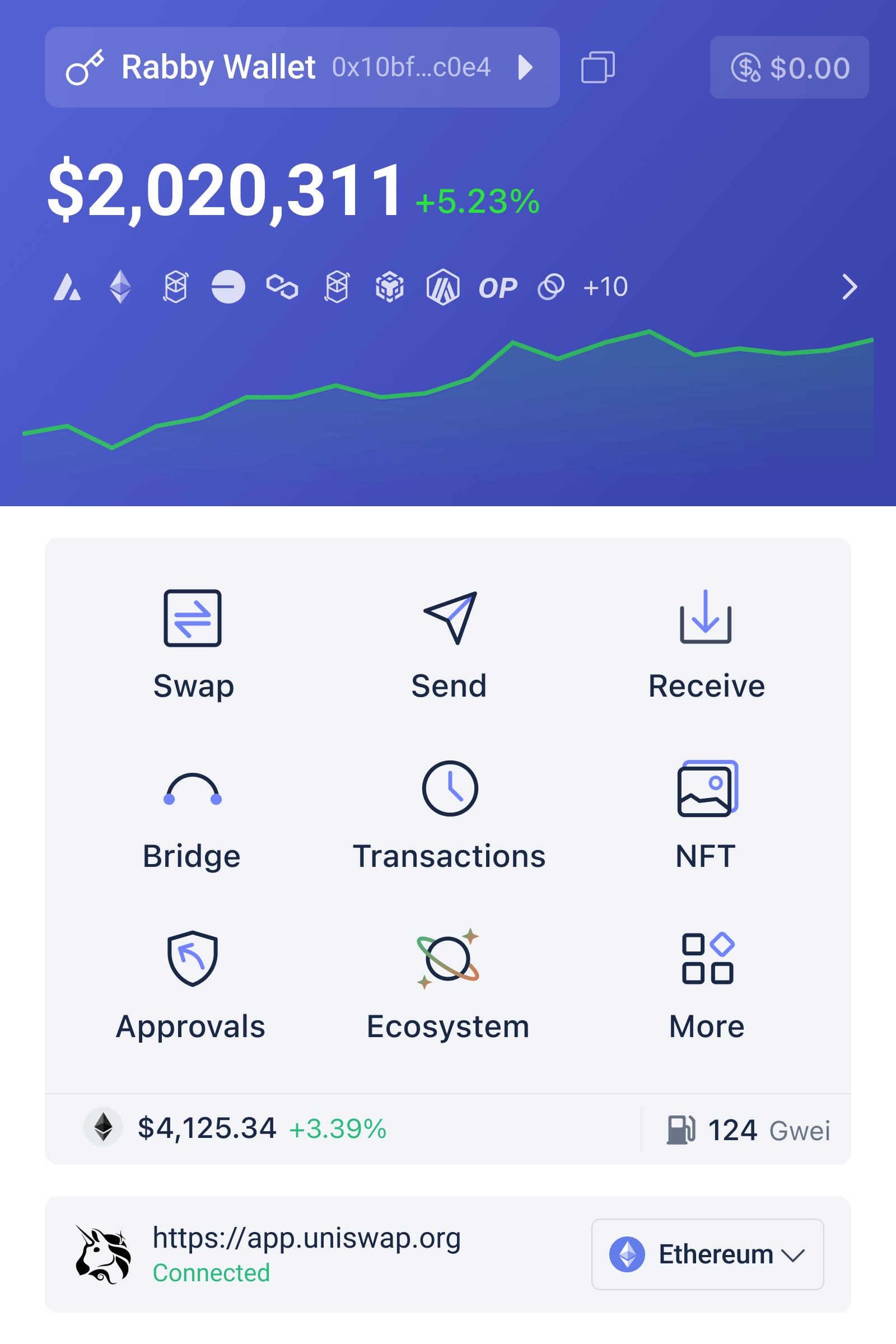
Au cœur, une extension de portefeuille agit comme un intermédiaire local entre votre navigateur et les applications décentralisées (dApps). Rabby implémente ce rôle en mettant l’accent sur trois mécanismes matériels pour l’utilisateur DeFi : isolation des permissions, gestion multi-chaînes et détection des risques transactionnels. L’isolation des permissions signifie que chaque dApp ne reçoit que l’accès minimal requis — adresse, signature d’une transaction spécifique — plutôt que l’autorisation permanente de dépenser tous vos jetons. Techniquement, cela se traduit par une interface UX qui expose les scopes de signature et par une couche logicielle qui peut verrouiller ou révoquer des approbations.
La gestion multi-chaînes (capacité à gérer actifs sur Ethereum, BSC, Arbitrum, etc.) est utile mais pas neutre : elle demande une cartographie claire des réseaux, des frais et des tokens. Rabby propose des listes et des outils de routage des transactions qui visent à réduire les erreurs de réseau (par exemple envoyer de l’Ether sur un réseau incompatible). Enfin, la détection des risques transactionnels est une fonction pratique : Rabby inspecte les appels de contrat et avertit quand une transaction contient des fonctions potentiellement dangereuses, comme setApprovalForAll ou des transferts vers des contrats non standard. C’est un effort d’ingénierie qui vise à réduire les erreurs humaines — mais ce n’est pas une garantie contre tous les types d’attaque.
Comparaison côte-à-côte : Rabby vs portefeuille extension « traditionnel » vs hardware+extension
Pour rendre la décision pratique, voici trois profils et la manière dont chaque option correspond aux priorités.
1) Priorité simplicité et usage occasionnel (ex : swaps simples sur Uniswap) : une extension « traditionnelle » (comme MetaMask) offre la voie la plus simple. Avantages : faible friction d’installation, large compatibilité dApps. Inconvénients : approbations générales fréquentes, moins d’avertissements transactionnels granulaire.
2) Priorité contrôle fin sur les permissions et activités multi-chaînes (utilisateur actif DeFi, yield farming) : Rabby se positionne ici. Avantages : contrôles d’approbation plus granulaires, affichage clair des risques, outils multi-chaînes intégrés. Inconvénients : courbe d’apprentissage plus prononcée que l’option la plus basique ; les alertes ne remplacent pas une stratégie de sécurité robuste.
3) Priorité sécurité maximale (montants importants, gestion institutionnelle ou long-term hodl) : hardware wallet + extension demeure la combinaison la plus sûre. Avantages : clés privées stockées hors ligne, signature physique requise. Inconvénients : coût matériel, processus plus lent pour les opérations fréquentes, parfois moins pratique pour le multi-chaîne si le hardware n’est pas intégré à tous les ponts.
Trade-offs pratiques et limites à connaître
Il y a trois limites concrètes à garder en tête lorsque vous considérez Rabby pour vos activités DeFi :
– Avertissements ≠ immunité : les détections automatiques réduisent les erreurs mais n’empêcheront pas une fraude sophistiquée (phishing ciblé, contrats malveillants déguisés). Conséquence : combinez Rabby avec des pratiques comportementales — vérification manuelle des adresses, utiliser des listes blanches, limiter les approbations.
– Friction vs sécurité : plus de contrôle signifie plus de prompts et de confirmations. Si vous tradez très fréquemment, vous devrez décider d’un niveau d’automatisation acceptable. Par exemple, refuser systématiquement toutes les approbations manuelles protège, mais peut rendre les opérations répétitives fastidieuses.
– Dépendance au navigateur et au système d’exploitation : une extension reste vulnérable aux compromissions locales (malware, extensions malveillantes). Les utilisateurs en Suisse, France, Belgique et Canada devraient penser à séparer les usages (machine dédiée pour DeFi) ou utiliser un hardware wallet pour les gros montants.
Erreur courante et correction de concept — la permission « illimitée »
Beaucoup pensent qu’une fois qu’une dApp reçoit une autorisation illimitée (approve max), elle peut siphonner instantanément tous vos tokens. Mécaniquement, cette autorisation permet au contrat autorisé d’appeler transferFrom pour déplacer une quantité jusqu’à la limite approuvée. La vulnérabilité réelle vient de contrats malveillants ou compromis par lesquels l’attaquant déclenche transferFrom. La stratégie pratique : limiter les approbations, révoquer régulièrement via des outils de gestion, et préférer des approbations pour des montants précis lorsque possible. Rabby facilite la visualisation et la révocation des approbations, ce qui réduit ce risque opérationnel.
Comment et quand télécharger Rabby — conseils pour la région francophone
Si vous cherchez à télécharger Rabby en tant qu’extension desktop ou à explorer la version mobile, faites-le toujours depuis une source vérifiée. Pour un point d’entrée simple et pédagogique, vous pouvez consulter la page dédiée : rabby wallet. Conseil pratique : installez d’abord sur un navigateur non critique, créez un portefeuille test (quelques euros/centimes), exécutez un swap sur un testnet ou une petite transaction réelle, puis montez en puissance si l’expérience vous convient.
En France, Suisse, Belgique et au Canada, la recommandation opérationnelle est la même : commencer par des montants faibles, activer les options de protection (notifications de transaction, révocation simple), et décider ensuite si vous liez un hardware wallet pour les fonds plus importants.
Un heuristique décisionnel réutilisable
Pour synthétiser : posez-vous trois questions avant d’adopter Rabby ou une autre solution :
– Quel est le montant/type d’actifs que j’expose (petite expérimentation vs réserve importante) ?
– Ai-je besoin de transactions fréquentes et rapides ou de contrôle fin sur chaque approbation ?
– Suis-je prêt à maintenir une discipline de sécurité (révocation régulière, machine dédiée, hardware pour les sommes élevées) ?
Si votre réponse penche vers contrôle et activité multi-chaînes, Rabby est souvent un bon compromis. Si la priorité est la simplicité, préférez une solution plus basique ; si la priorité est la sécurité ultime, combinez hardware + extension.
Que surveiller ensuite — signaux et développements utiles
Trois choses à suivre qui peuvent changer la balance : l’amélioration des protocoles d’approbation (standards ERC qui limitent automatiquement les risques d’approbations illimitées), les audits et programmes de bug bounty (plus d’audits publics réduisent l’incertitude), et l’interopérabilité hardware+extension (meilleure intégration rendra la sécurité moins contraignante). Ces signaux sont conditionnels : aucun ne garantit une solution parfaite, mais leur évolution informe votre choix de timing pour migration ou adoption.
FAQ
Rabby Wallet est-il adapté aux débutants en DeFi ?
Oui, mais avec réserves : l’interface vise la clarté, et les aides à la détection de risque aident les débutants. Cependant, l’utilisateur débutant doit apprendre les bases des permissions et commencer avec de faibles montants pour limiter l’impact d’une erreur. La courbe d’apprentissage est plus élevée que pour une extension très basique, mais la valeur pédagogique est supérieure.
Puis-je utiliser Rabby avec un hardware wallet ?
Techniquement, l’intégration de hardware wallet avec des extensions est possible et souhaitable pour des fonds importants. Vérifiez la compatibilité du modèle hardware et testez la configuration avant d’y transférer des sommes significatives. Même avec un hardware, conservez des pratiques de révocation et vérification des contrats.
Les alertes de Rabby remplacent-elles un audit personnel des contrats ?
Non. Les alertes réduisent le risque d’erreur, mais elles ne remplacent pas une vigilance humaine. Comprendre ce que vous signez — lire les fonctions appelées, vérifier les adresses et limiter les autorisations — reste indispensable.
Quel est le meilleur flux pour un utilisateur franco-canadien qui veut sécuriser 10 000 EUR en crypto ?
Un flux prudent : stocker la majorité sur un hardware wallet, utiliser une machine dédiée ou un profil navigateur séparé pour les opérations DeFi, utiliser Rabby pour les interactions quotidiennes si vous avez besoin de multi-chaînes, et limiter/contrôler chaque approbation. Adaptez le niveau de sécurité à la valeur et à la fréquence des transactions.
We’ll focus on mechanisms: what triggers verification steps, how different product lines are separated legally and operationally, and what those separations mean for risk and protection. You’ll also get a decision-useful checklist for common scenarios — opening an account, enabling options or margin, setting up recurring investments, or attempting a fast withdrawal — and a few watchpoints for the near future.

How Robinhood’s Verification and Login System Actually Works
At a systems level, verification is layered. The first layer is identity verification: name, SSN, date of birth, and address. This is a legal baseline used to open a brokerage account and comply with KYC (know-your-customer) regulations. The second layer is device and session security: passwords, multi-factor authentication (MFA), device recognition, and login alerts. The third layer is product entitlement: approvals or restrictions that determine whether you can trade stocks, options, margin, or crypto. Each layer uses different data and serves distinct regulatory or operational purposes.
Identity checks are matched against databases and documents; mismatches or high-risk flags can trigger additional document requests (proof of address, ID photos). Device-level controls (MFA, push verification) reduce account takeover risk but add friction when you switch phones or travel. Product entitlement relies on suitability checks — questions about income, investment experience, and risk tolerance — and in the case of margin or options, sometimes further underwriting steps. For crypto, Robinhood operates through separate regulated entities, so verification and disclosures can differ from securities trading: that structural separation matters for both access and consumer protections.
Difference in Protections: SIPC, Crypto, and Cash Features
A common misconception is that everything in a brokerage account is equally protected. Mechanically, SIPC protects against brokerage failure for eligible cash and securities up to statutory limits; it does not protect against market losses. Crypto assets, in most cases, fall outside SIPC coverage because they are offered through a different legal entity and are treated differently under current rules. That means when a verification or custody issue arises for crypto, the remediation path and speed can differ from a securities problem.
Robinhood also offers cash management and card features in certain markets. Those features have their own terms and may be subject to deposit insurance or sweep programs that are distinct from SIPC. Practically, when you complete verification to enable spending features, you are entering a different contractual arrangement than when you verify for stock trading. Treat each product line as its own permissioned subsystem: verification for one does not automatically imply the same protections or rules for another.
Triggers, Delays, and What They Mean for Your Trades
When will you face a hold or extra verification? Typical triggers include: new device logins, large transfers or withdrawals, requests to enable options or margin, suspicious activity flags, or inconsistent identity data. Operationally, verification can take minutes (a push approval) or several business days (document review). That timing matters: recurring investment workflows and fractional share purchases may queue or settle differently when an account is under review.
Two practical consequences follow. First, automation is helpful but not fail-safe: you can schedule recurring investments to dollar-cost average, but if verification blocks trading at the scheduled time, purchases may miss specific market windows. Second, product-enabling events (like approving options trading) often require a review of trading experience and finances — and regulators expect brokers to document suitability. If you’re planning to trade options or margin, start the verification well before you need to use those features.
Comparing Two Common States: Standard Verified Account vs. Elevated Entitlements
Side-by-side comparison helps choose the right path for your goals.
Standard verified account (baseline): You can trade stocks and ETFs, use fractional shares, and set up recurring investments. SIPC protection applies to eligible securities and cash within limits. Login security is typically password + MFA. This setup is best for buy-and-hold retail investors focused on low-maintenance portfolios.
Elevated entitlements (options/margin/crypto active): You must supply additional suitability information; margin and options add complexity and leverage risk; crypto may be handled by a separate entity with different custody rules and no SIPC coverage. Instant deposits or higher instant-buy limits may require Robinhood Gold or additional verification. This setup is for experienced traders who accept higher operational complexity and tailored protections.
Trade-offs and who they fit
Choose baseline verification if your priority is long-term simplicity and SIPC-eligible securities. Choose elevated entitlements when active strategies, options income, or faster settlement are necessary — but budget attention to monitoring, risk management, and the likelihood of additional holds or margin calls. Fractional investing lowers the dollar barrier to entry but does not change market risk; it can complicate tax lots and wash-sale tracking in practice.
Security Controls: How to Reduce Friction Without Sacrificing Safety
Security and convenience often collide. Enabling multi-factor authentication and device recognition significantly reduces account takeover risk, but it means you need to plan for device changes. Best practices: register more than one MFA method where possible, keep a current email and phone number on file, and consider a hardware security key if available. Set up account alerts so unusual activity triggers immediate action.
Also, consider how you fund the account. Linking and verifying a bank account in advance reduces the chance of a hold when you make transfers. If you’re trying to use a new bank during a verification review, expect timing delays while micro-deposits or ownership checks complete.
Decision-Useful Checklist: What to Do When You Hit a Verification Hold
1. Read the request carefully — it will usually state exactly what documents or steps are required.
2. Prioritize identity and funding verification before enabling new products like options or margin.
3. If you have a pending recurring transaction, expect it to be queued or delayed; contact support if the timing is critical.
4. For crypto-specific holds, remember custody and legal protections differ; escalate through the crypto service’s disclosed channels if needed.
5. Keep records of communications and uploaded documents until the issue resolves; that helps if you need to appeal or provide extra proof.
Non-Obvious Insights and Misconceptions Corrected
Misconception: “Verification is just bureaucracy.” Correction: verification is how the platform enforces legal identity, anti-fraud, and suitability obligations; it’s also how they segment legal liability across entities. That segmentation explains why a crypto hold behaves differently from a stock trading hold.
Non-obvious insight: Faster access (instant deposits, instant buying) often depends on both platform policy and your verified history — accounts with longer positive histories experience fewer friction points for higher instant limits. That means patience and conservative early behavior can reduce future verification friction.
Another practical point: recurring investment automation reduces timing risk but not verification risk. If your account lacks the proper entitlements at the exact execution time, the system generally won’t override compliance checks — the scheduled buy may fail or be postponed.
What to Watch Next
Regulatory scrutiny of retail trading features and crypto custody continues to evolve. Watch for clarifications around custody rules for crypto, and any rulemaking that narrows or expands protections that currently rest outside SIPC. Also watch product announcements about 24/5 trading windows, instant-settlement enhancements, or expanded cash management features — each change can alter verification triggers or required disclosures.
If you want to get straight into your account console from a secure, bookmarkable page, use this entry point to manage your credentials and entitlements: robinhood sign in.
Practical Takeaways
1. Treat verification as part of your investment process: plan verification steps before you need advanced products, not during a time-sensitive trade.
2. Separate goals by product: if you primarily want straightforward ETF investing, keep the account at baseline entitlement; if you need options, start the upgrade early and accept the added oversight.
3. Use security best practices proactively — multiple MFA methods, up-to-date contact info, and registered devices — to reduce friction and the risk of lockouts.
FAQ
Why did Robinhood ask for extra verification when I tried to enable options?
Options trading requires additional suitability checks because it can involve leverage and complex payoff structures. The platform evaluates your income, net worth, trading experience, and understanding of risks. If information is missing or inconsistent, Robinhood will request documents or deny the entitlement until the suitability standard is met.
Does SIPC protect my crypto assets if Robinhood freezes my account?
Generally no. SIPC protects eligible brokerage cash and securities, not most crypto assets. Robinhood’s crypto services are often provided through a separate entity with distinct custody arrangements, so the protections and remediation path differ. If custody is a primary concern, compare the custody disclosures and insurance terms for crypto specifically.
How long does verification usually take?
Simple device-based verifications can be seconds to minutes. Document reviews and identity confirmation can take a few business days. If you need immediate access for trading, start verification well before your target date and avoid funding moves that could trigger additional checks.
Will enabling Robinhood Gold make verification faster?
Robinhood Gold provides features like higher instant-deposit limits and research tools, but it does not bypass regulatory verification requirements. It may offer operational conveniences for funded accounts, but entitlements like margin and options still require suitability checks and possible documentation.
What should I do if I travel and get locked out by verification checks?
Before travel, update your account contact info and register your device if possible. If locked out, use any backup MFA method, contact support promptly, and have identity documents ready for upload. Avoid initiating large transfers while traveling if you anticipate stricter device checks.